 Skip to content
Q) Bisectors of angles A, B and C of a triangle ABC intersect its circumcircle at D, E and F, respectively. Prove that the angles of the triangle DEF are 90°–  , 90°–
  and 90°–
  .
.
9th Class Maths – NCERT Important Questions
Ans:
Step 1: Let’s make a diagram for better understanding of the question:
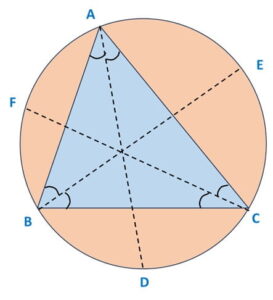
Here, ABC is a triangle inside the circle. AD, BE and DF are bisectors of ∠ A, ∠ B an ∠ C respectively.
Step 2: Let’s connect AE. 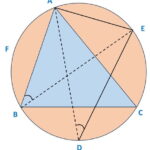
We know that angles in same segment are always equal,
∴ ∠ ABE = ∠ ADE
∵ BE is bisecor of ∠ B
∴ ∠ ABE = ∠ ADE = ………. (i)
Step 3: Let’s connect AF. 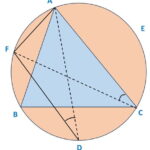
∵ angles in same segment are always equal,
∴ ∠ ACF = ∠ ADF
∵ CF is bisecor of ∠ C
∴ ∠ ACF = ∠ ADF = ………. (ii)
Step 4: Now, value of ∠ D = ∠ ADE + ∠ ADF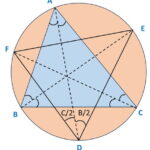
∴ ∠ D = 
∴ ∠ D =  (B + C) ….. (iii)
Step 5: In Δ ABC, ∠ A + ∠ B + ∠ C = 1800
∴ ∠ B + ∠ C = 1800 – ∠ A ………. (iv)
Now, by substituting equation (iv) in equation (iii), we get:
∴ ∠ D = (B + C) .
∴ ∠ D = (1800 – ∠ A)
∴ ∠ D = 900 –
Similarly, ∠ E = 900 –
and ∠ F = 900 –
Hence Proved!
Please press the “Heart” button if you like the solution.
📚 Get Free Worksheet & Share Solution
To download the practice worksheet for this specific topic:
💬 Ask for WorksheetTo help your classmates with this helpful math solution:
Share with Friends