 Skip to content
Q) A group of friends wanted to play cards with two identical packs together. While shuffling the cards, three cards are dropped. Rest of the cards are shuffled and one card is drawn at random. Assuming that the dropped cards were a queen of hearts, a ten of spades and an ace of clubs, answer the following questions:
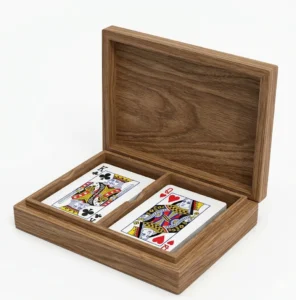
- Find the probability that the drawn card is a face card.
- Find the probability that the drawn card is either a king or a queen.
- Do you think that the probability of getting a queen was higher if none of the cards were dropped? Justify your answer.
- Find the probability that the drawn card is a jack. Compare it with the probability when none of the cards were dropped. In which case is the probability of getting a jack higher?
(Q 38 – 30/3/3 – CBSE 2026 Question Paper)
Ans:
It is given that there are two identical packs of cards.
∴ total number of cards = 52 x 2 = 104 cards
Now, 3 cards (Queen of hearts, a Ten of spades and an Ace of clubs) are dropped
∴ total outcomes = 104 – 3 = 101
Among these remaining 101 cards, now we have: 25 hearts, 25 spades, 25 clubs and 26 diamonds.
Also there are 23 face cards iwhich includes 8 Kings, 7 Queens, 8 Jacks.
(i) Probability of getting a face card:
∵ In remaining cards, there are 23 face cards,
∴ Favourable outcomes for this case = 23
Since probability = 
∴ Probability of getting a face card, PFC = 
(ii) Probability of getting a king or a queen:
∵ In remaining cards, there are 8 Kings and 7 Queens,
∴ Favourable outcomes for this case = 8 + 7 = 15
Since probability =
∴ Probability of getting a King or Queen, PKQ = 
(iii) Deciding on Probability of getting a Queen:
Case 1: Probability of getting a queen with no drop:
∵ Originally (no card drop), total number of cards = 104
∴ Total outcomes = 104
∵ There were 8 Queens originally,
∴ Favourable outcomes for this case = 8
Since probability =
∴ Probability of getting a Queen originally, PQO = 
Case 2: Probability of getting a queen with 3 cards dropped:
∵ As calculated in earlier steps, after drop, total outcomes = 101
∵ In remaining cards, there are 7 Queens,
∴ Favourable outcomes for this case = 7
Since probability =
∴ Probability of getting a Queen after drop, PQD = 
Now, we compare, PQO with PQD:
= 
∵ The difference > 0 ∴ PQO > PQD
Therefore, the probability of getting a queen was higher before the cards drop.
(iv) Deciding on probability of getting a Jack:
Case 1: Probability of getting a Jack with no cards dropped:
∵ As calculated in part (iii), total outcomes before drop = 104
∵ There were 8 Jacks originally,
∴ Favourable outcomes for this case = 8
Since probability =
∴ Probability of getting a Jack originally, PJO =
Case 2: Probability of getting a Jack with 3 cards dropped:
In this case, Total outcomes after drop = 101
∵ Jack is not among the 3 dropped cards
∴ Favourable outcomes for this case = 8
∴ Probability of getting a Jack after the drop, PJD = 
Now we compare, PJO with PJD:
= 
∵ The difference < 0 ∴ PJO < PJD
Therefore, the probability of getting a Jack is higher after the cards drop.
Please press “Heart” if you liked the solution.