 Skip to content
Q) A metallic cylinder has radius 3 cm and height 5 cm. To reduce its weights, a conical hole is drilled in the cylinder. The conical hole has a radius of  cm and its depth
  cm. Calculate the ratio of the volume of metal left in the cylinder to the volume of metal taken out in conical shape.
Ans:
Step 1: ∵ Volume of the cylinder = π r 2 h
For cylinder, radius = 3 cm and height = 5 cm (given)
∴ Cylinder’s volume = π × (3)2 × 5 = π × 9 × 5 = 45 π cm3
Step 2: ∵ Volume of the cone =  π r 2 h
For conical hole, radius = cm and height = cm (given)
∴ Conical hole’s volume = 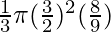
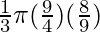
= 
=  π cm3
π cm3
Step 3: ∵ Volume of remaining body = Cylinder volume – Conical hole’s volume
= 45 π – π
=  π cm3
π cm3
Step 4: ∵ Ratio of volumes of metal left to metal taken out:
= Volume of remaining body : Volume of conical hole
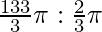
= 
= 133 : 2 = 66.5 : 1
The required ratio of metal’s volume is 66.5 : 1
Please press the “Heart” button if you like the solution.