 Skip to content
Q) The angle of elevation of the top of a vertical tower from a point P on the ground is 60°. From another point Q, 10 m vertically above the first point P, its angle of elevation is 30°. Find:
(a) The height of the tower.
(b) The distance of the point P from the foot of the tower.
(c) The distance of the point P from the top of the tower.
Ans:
Let’s start from the diagram for the question:
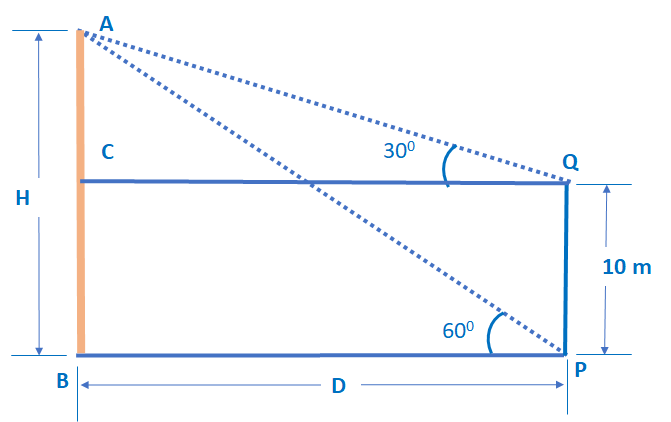
Let ‘s take AB as a tower with the height as ‘H’ and the distance of point P from the foot of the tower as ‘D’. Given that the Point Q is 10 m high vertically above the point P. Angles from both points are also plotted.
(a) The height of the tower (H):
In Δ ABP, tan P = 
Since, ∠ APB = 600 , AB = H, BP = D
∴ tan 600 = √3 = 
∴ D =  …………. (i)
(Note: Here we calculate D in terms of H, because when we substitute value of D, we will get all H terms together and value of H will be calculated.)
Next, in Δ ACQ, tan Q = 
Since, ∠ AQC = 300 , AC = H – 10, CQ = BP = D
∴ tan 300 = 
∴ D = (H – 10) √3 …………. (ii)
By substituting, value of D from equation (i) in equation (ii), we get:
= (H – 10) √3
H = 3 (H – 10)
H = 3H – 30
2H = 30 or H = 15
Therefore, the height of the tower AB is 15 m.
(b) The distance of the point P from the foot of the tower (PB):
from equation (i),
D =
We just calculated, H = 15 m, therefore,
D =  = 5 √3
Therefore, the distance of the point P from the foot of the tower (PB) is 5 √3 m.
(c) The distance of the point P from the top of the tower (AP).
In Δ ABP, sin P = 
Since, ∠ APB = 600 , AB = H = 15,
∴ sin 600 = 
AP √3 = 30
AP =  = 10√3
Therefore, the distance of the point P from the top of the tower is 10 √3 m.