 Skip to content
Q) Represent the following pair of linear equations graphically and hence comment on the condition of consistency of this pair: x – 5 y = 6; 2 x – 10 y = 12.
(Q 33 – 30/2/2 – CBSE 2026 Question Paper)
Ans:
We are given following two equations:
1. x – 5 y = 6
2. 2 x – 10 y = 12
(i) Graphical representation:
Step 1: To plot on graph, let’s calculate point where these lines, cut x-axis and y-axis:
1. For equation 1: x – 5 y = 6:
∵ on Y-axis, x = 0; ∴ for x = 0, y = – 
Line will pass through (0, – )
and ∵ on X-axis, y = 0; ∴ y = 0, x = 6
Line will pass through (6, 0)
2. Now, for equation: 2 x – 10 y = 12
for x = 0, y = – 
Line will pass through (0, – )
for y = 0, x =  = 6
= 6
Line will pass through (6, 0)
Step 2: Next, we plot these 2 equations on graph.
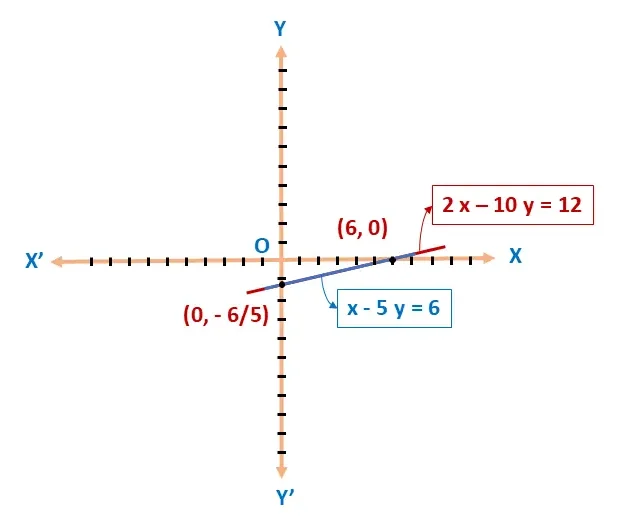
We can see that both equations are identical and they represent the same straight line.
(ii) Comment on Consistency:
[Note: Before commenting on “on the condition of consistency of the given pair of linear equations”; let’s first understand the consistency & dependency conditions of linear equations:
A. A system of linear equations is “CONSISTENT” if it has at least one solution. This includes two cases:
(i) Unique solution: The two lines intersect at exactly one point. In such pair, 
(ii) Infinite solutions: The two lines coincide i.e. lie on top of each other. It means that each point on a line is a solution, as it lies on other line as well. Such a pair of linear equations is also “DEPENDENT“, where one equation is a continuous multiple of the other, representing the same line. This leads to infinitely many solutions. In such pair, 
B. A system of linear equations is called “INCONSISTENT“, if it has no solution. Such lines are parallel lines and do not intersect at any point.
In such pair, 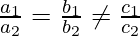 ]
]
Step 3: We are given pair of linear equations as:
1. x – 5 y = 6
∴ x – 5 y – 6 = 0
and 2 x – 10 y = 12 or
∴ 2 x – 10 y – 12 = 0
Let’s compare our given pair of equations with standard pair of linear equations: a1 x + b1 y + c1 = 0 and a2 x + b2 y + c2 = 0
We have a1 = 1, b1 = – 5, c1= – 6 and a2 = 2, b2 = – 10, c2 = – 12
Step 4: By comparing ratios of coefficients, we get:
 ;
;
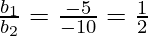 ;
;
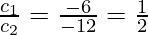 ;
;
∵ For this pair of linear equations,
Therefore, these lines are consistent and dependent. Both lines will have infinitely many solutions.
Final Answer: Graphically, both equations represent the same line. and Condition-wise, both equations are consistent and dependent with infinitely many solutions.
Please press the “Heart” button if you like the solution.
📚 Get Free Worksheet & Share Solution
To download the practice worksheet for this specific topic:
💬 Ask for WorksheetTo help your classmates with this helpful math solution:
Share with Friends