 Skip to content
Q) A rocket is in the form of a right circular cylinder closed at the lower end and surmounted by a cone with the same radius as that of cylinder. The diameter and height of cylinder are 6 cm and 12 cm, respectively. If the slant height of the conical portion is 5 cm, then find the total surface area and volume of rocket. (Use π = 3.14)
Ans:
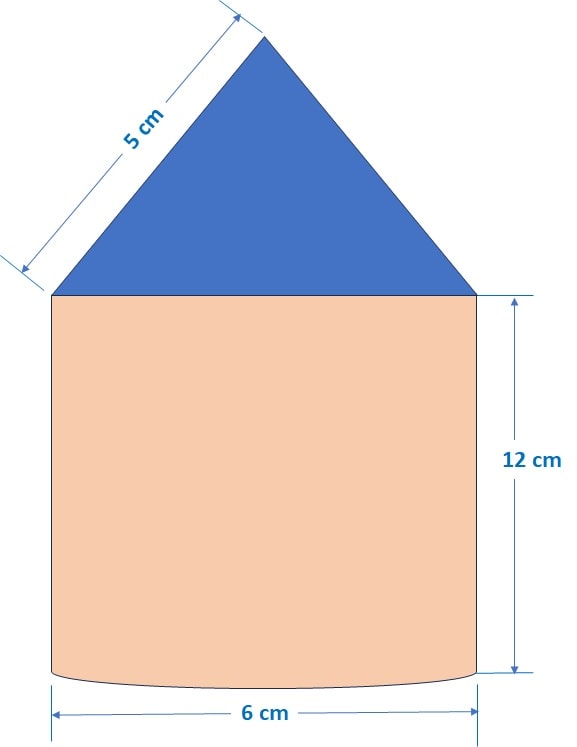
We are given that, diameter of cylinder, D = 6 cm ∴ radius of cylinder, R = 3 cm
Since radius of cylinder = radius of cone,
∴ diameter of cone, d = 6 cm ∴ radius of cone, r = 3 cm
Height of the cylinder, H = 12 cm
Slant height of the cone, l = 5 cm
Step 1: Height of the cone, h =  (slant ~ height^2 – radius ~ of ~ cone^2)
=  = 4 cm
Step 2:
Curved surface area of the cone =  r l = (3) (5) = 15
Curved surface area of the Cylinder = 2 R H = 2 (3)(12) = 72
Base area of the Cylinder = R^2 = (3)^2 = 9
∴ Total Surface Area of the rocket = Surface Area of Cone + Surface Area of Cylinder + Base Area of Cylinder
= 15 + 72 + 9 = 96 = 96 x 3.14 = 301.44 cm2
Therefore, the Surface Area of the Rocket is 301.44 cm2
Note: Here, base area of cylinder is taken because it is given that the cylinder is closed.
Step 3:
Volume of the Cone =  r2 h = (3)2 (4) = 12
Volume of the Cylinder = R2 H = (3)2 (12) = 108
Volume of the rocket = Volume of Cone + Volume of Cylinder
= 12 + 108 = 120 = 120 x 3.14 = 376.8 cm3
Therefore, the Volume of the Rocket is 376.8 cm3