 Skip to content
Q) ‘Kolam’ is a decorative art which is made with rice flour in South Indian States. It is drawn on grid pattern of dots. One such art work is shown below.
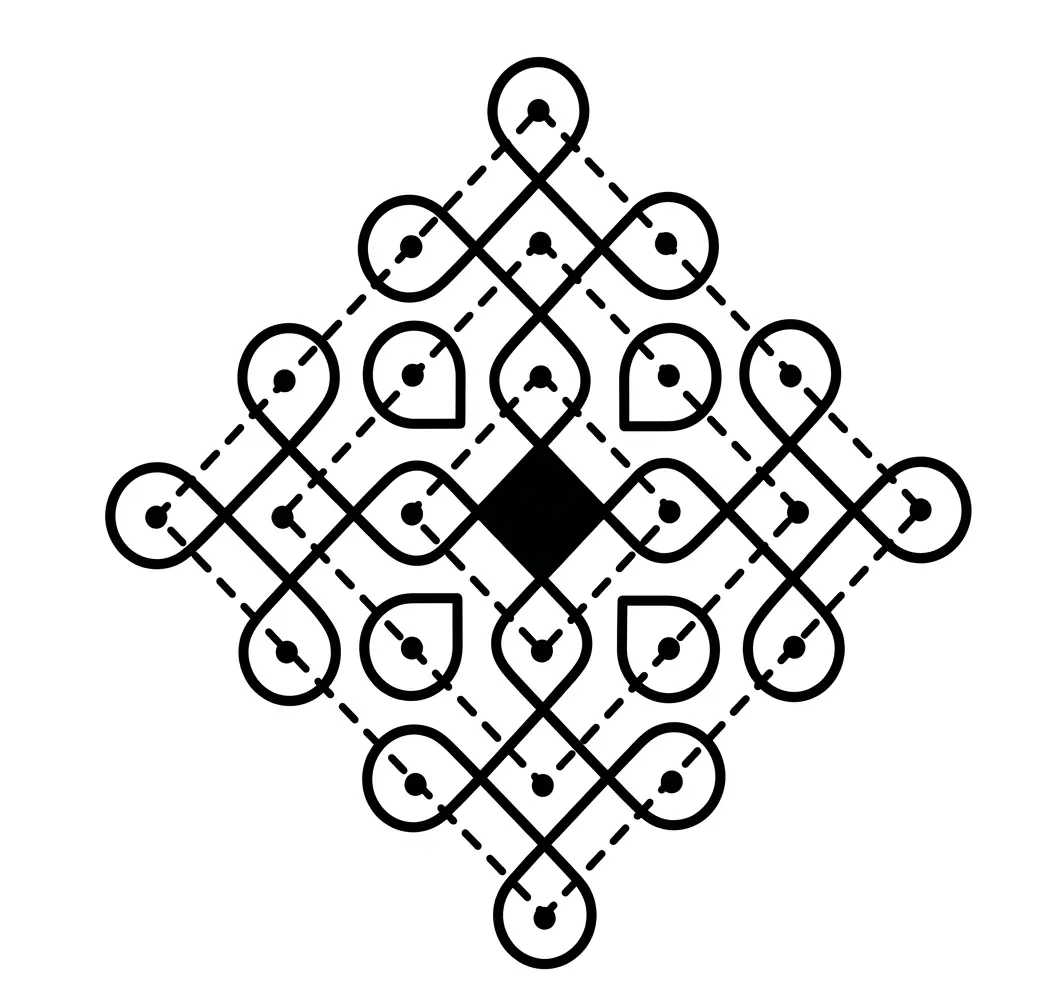
Observe the given figure carefully. There are 4 dots in first square, 8 dots in second square, 12 dots in third square and so on. Based on the above, answer the following questions:
(i). Show that number of dots given above form an A.P. Write the first term and common difference.
(ii). Write nth term of the A.P. formed.
(iii). The pattern is expanded on a large ground. If total 220 dots are used, then find the number of squares formed.
(iv). Is it possible to complete n number of squares using 100 dots? If yes, then find the value of n.
(Q 36 – 30/4/2 – CBSE 2026 Question Paper)
Ans:
(i) AP formation:
An AP is a sequence where the difference between any two consecutive terms is same.
Now, number of dots in the 1st square, a1 = 4
Number of dots in the 2nd square, a2 = 8
Number of dots in the 3rd square, a3 = 12
Here, first term, a1 = 4
Common difference, d = a2 – a1 = 8 – 4 = 4
Also, a3 -a2 = 12 – 8 = 4
Here the difference between consecutive terms is same
Therefore, the sequence forms an Arithmetic Progression.
(ii) nth term of the A.P.:
We know that the nth term of an AP is given by: Tn = a + (n – 1) d
Substituting the values of a and d (from part i ):
Tn = 4 + (n – 1) (4) = 4 + 4 n – 4 = 4 n
Therefore, the nth term of the AP is 4n.
(iii) Number of squares for 220 dots:
It is given that grid pattern has dots in a square.
Here, we are given the total number of dots as 220 and we need to find the number of squares.
Let’s consider that there are n squares,
then total number of dots used in n squares, Sn =  [2 a + (n – 1) d]
Since it is given that Sn = 220
∴ 220 = [2 (4) + (n – 1) (4)]
∴ 220 = [8 + 4 n – 4]
∴ 220 = (n + 1) 4
∴ 110 = n (n + 1)
∴ 110 = n 2 + n
∴ n 2 + n – 110 = 0
By mid-term splitting,
n 2 + 11 n – 10 n – 110 = 0
∴ n (n + 11) – 10 (n + 11) = 0
∴ (n + 11) (n – 10) = 0
∴ n = – 11 and n = 10
Here, we reject n = – 11, because no. of squares (n) can not be negative
We accept, n = 10
Therefore, the number of squares is 10.
(iv) Checking usage of exactly 100 dots:
If 100 dots are used in n squares, then value of n will be an integer.
∴ 4 n = 100
∴ n = 
∴ n = 25
Since 25 is an integer, exactly 100 dots can complete 25 squares.
Please press the “Heart” button if you like the solution.