 Skip to content
Q) Prove that: 
(Q 30 – 30/4/2 – CBSE 2026 Question Paper)
Ans:
[Note: solved in two methods: please choose whichever you find easier]
Method 1:
Step 1: Let’s start from LHS and simplify it:
LHS = 
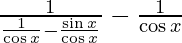
= 
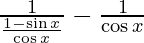
= 
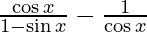
= 
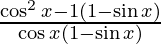
= 
= 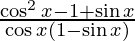
∵ by trigonometric identity, sin 2 θ + cos 2 θ = 1
∴ LHS = 
∴ LHS = 
∴ LHS = 
∴ LHS = 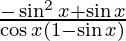
∴ LHS = 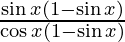
∴ LHS = 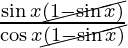
∴ LHS = 
∴ LHS = tan x
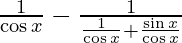
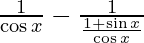
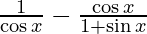
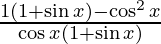
Step 2: Let’s take RHS & simplify it:
RHS = 
= 
= 
= 
= 
= 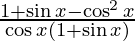
∵ by trigonometric identity, sin 2 θ + cos 2 θ = 1
∴ RHS = 
∴ RHS = 
∴ RHS = 
∴ RHS = 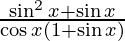
∴ RHS = 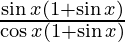
∴ RHS = 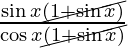
∴ RHS =
∴ RHS = tan x
Since LHS = RHS…….. Hence proved!
Method 2:
Given expression is:
Step 3:
We can rearrange the given terms to make it simpler:
∴ 
∴ 
Now, this is simpler form of given experession and we will try to prove if ts LHS is equal to RHS
Step 4: Let’s start from LHS:
LHS = 
= 
= 
= 
= 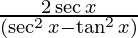
Step 5: ∵ by trigonometric identity: 1 + tan 2 θ = sec 2 θ
∴ sec 2 θ – tan 2 θ = 1
By substituting this value in our LHS expression, we get:
∴ LHS = 
= 2 sec x = RHS (of derived expresion in step 3)
Hence Proved !
Please press “Heart” if you liked the solution.