 Skip to content
Q: Your elder brother wants to buy a car and plans to take a loan from a bank for his car. He repays his total loan of ₹ 1,18,000 by paying every month, starting with the first instalment of ₹ 1,000 and he increases the instalment by ₹ 100 every month. Based on the information given above, answer the following questions:
(i) Find the amount paid by him in the 30th instalment.
(ii) If the total number of instalments is 40, what is the amount paid in the last instalment ?
(iii) What amount does he still have to pay after the 30th instalment?
(iv) Find the ratio of the tenth instalment to the last instalment.
[Q 38 – 30/2/2 – CBSE 2026 Question Paper]
Ans:
We are given the following values:
Total loan = ₹ 1,18,000
First instalment = ₹1,000
Each instalment increases by ₹100 every month
Therefore, this forms an Arithmetic Progression (AP):
Here, first term, a = 1000
and Common difference, d = 100
(i) Amount paid in the 30th installment:
We can get this amount by finding the value of 30th term.
Since the value of nth term is given by, Tn = a + (n – 1) × d
∴ T30 = 1000 + (30 – 1) × 100
= 1000 + 2900 = ₹ 3,900
Therefore, amount paid in the 30th instalment is ₹ 3,900.
(ii) Amount paid in the last instalment:
Since 40th instalment is the last instalment, we can get this amount by finding the value of 40th term.
Again by nth term formula, Tn = a + (n – 1) × d
∴ T40 = 1000 + (40 – 1) × 100
= 1000 + 3900 = ₹ 4,900
Therefore, amount paid in the last instalment is ₹ 4,900.
(iii) Balance amount to be paid after 30 instalments:
Here, we can see that amount is being paid right from 1st to 30th instalments.
So if we find out total amount paid in these first 30 instalments, we can find out the amount yet to be paid.
Step 1: Let’s calculate the total amount paid in 30 instalments:
Since sum of first n terms of an AP is given by: Sn =  [2 a + (n – 1) d]
∴ Sum of first 30 terms, S30=  [2 (1000) + (30 – 1) (100)]
= 15 x (2000 + 2900) = 15 × 4900
= ₹ 73,500
Step 2: It is given that total loan amount to be paid is ₹ 1,18,000
Balance amount = 1,18,000 – 73,500
= 44,500
Therefore, after paying 30 instalments, ₹ 44,500 are yet to be paid.
(iv) Ratio of 10th instalment to last instalment:
To calculate this ratio, first we need to have value of 10th and last instalments.
Step 1: First we calculate value of 10th instalment by nth term formula:
∵ Tn = a + (n – 1) × d
∴ T10 = 1000 + (10 – 1) × 100
= 1000 + 900 = 1,900
∴ T10 = ₹ 1,900
Step 2: Next, we need to find value of last instalment
and for this we need to find which term is last instalment
Since, it is given that total loan amount is ₹ 1,18,000
Let’s consider n installments are paid
∵ Sn = [2 a + (n – 1) d]
∴ 118000 = [2 (1000) + (n – 1) (100)]
∴ 1180 = [2 (10) + (n – 1)]
∴ 1180 x 2 = n (20 + n – 1)
∴ 2360 = n (19 + n)
∴ n 2 +19 n – 2360 = 0
∴ n 2 + 59 n – 40 n + 2360 = 0 (by mid term splitting)
∴ n ( n + 59) – 40 (n – 59) = 0
∴ (n + 59) (n – 40) = 0
∴ n = – 59 and n = 40
Since value of n can not be negative, hence we reject n = – 59
and accept n = 40
40th instalment is the last instalment
Step 3: Now, we know that 40th instalment is the last instalment
and its value already calculated in part (ii),
∴ T40 = ₹ 4,900
Step 4: ∴ Ratio = 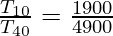
∴ T10 : T40 = 19 : 49
Therefore, the ratio of 10th and the last (40th) instalment is 19:49.
Please do press “Heart” button if you liked the solution
📚 Get Free Worksheet & Share Solution
To download the practice worksheet for this specific topic:
💬 Ask for WorksheetTo help your classmates with this helpful math solution:
Share with Friends