 Skip to content
Q) In the given figure, TP and TQ are tangents to a circle with centre M, touching another circle with centre N at A and B respectively. It is given that MQ = 13 cm, NB = 8 cm, BQ = 35 cm and TP = 80 cm.
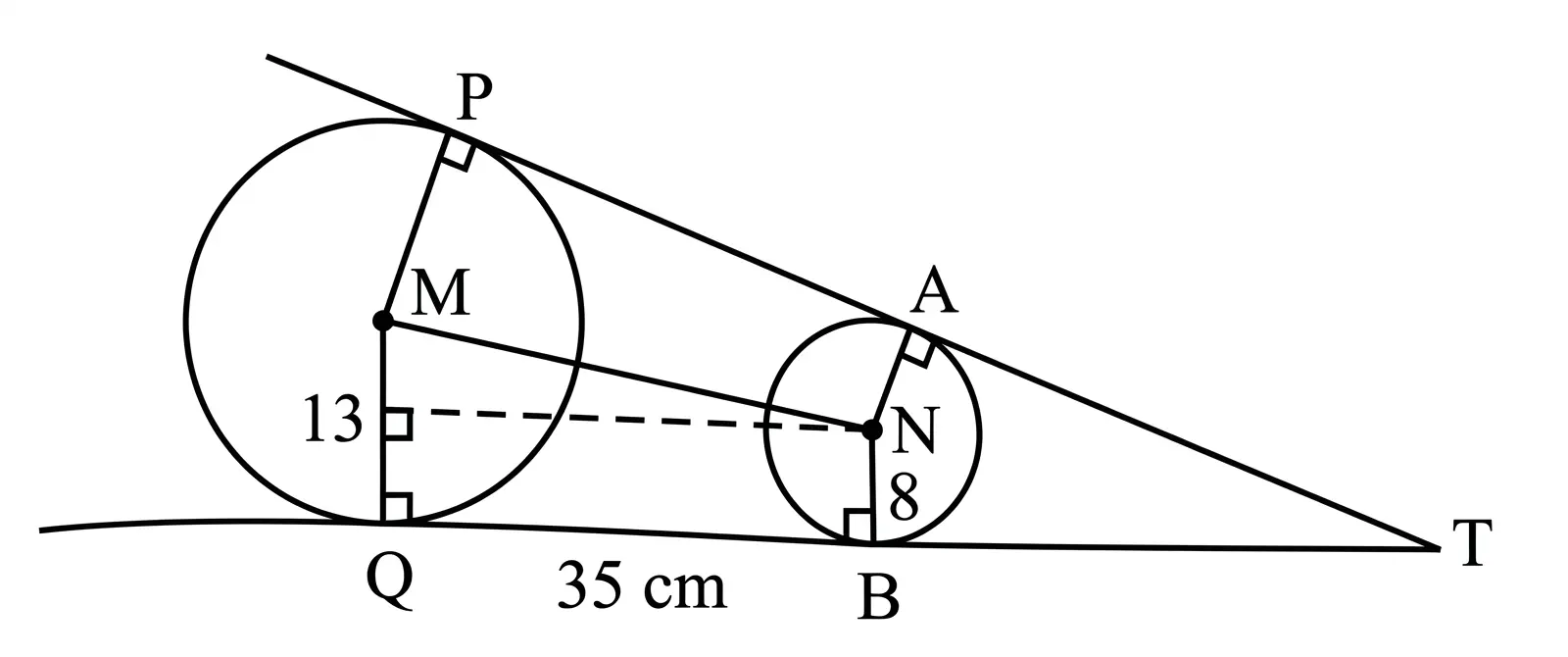
(i) Name the quadrilateral MQBN.
(ii) Is MN parallel to PA? Justify your answer.
(iii) Find length TB.
(iv) Find length MN.
(Q 35 – 30/4/2 – CBSE 2026 Question Paper)
Ans:
(i) Name the quadrilateral MQBN:
MQ and NB are radii of the circles and line TBQ is common tangent to the circles.
Since a radius is perpendicular to the tangent at the point of contact,
∠ MQB = 90 0 and ∠ NBQ = 90 0.
∵ both lines are perpendicular to the same line TBQ
∴ MQ is parallel NB.
We know that the a quadrilateral with one pair of parallel sides is a trapezium.
Therefore, the quadrilateral MQBN is a trapezium.
(ii) Is MN parallel to PA?
From the figure, MN is the line segment connecting the centers of the two circles
PA is a segment on the common tangent line TPA.
Since, these two lines intersect at point T, hence these 2 lines can not be parallel.
Therefore, MN is not parallel to PA.
(iii) Length of TB:
∵ Since the tangents from an external point are equal.
∴ TQ = TP = 80 cm (Tangents from T on large circle)
Given, BQ = 35 cm
∵ TB = TQ – BQ
∴ TB = 80 – 35 = 45 cm
Therefore, Length of TB is 45 cm
(iv) Length of MN:
Let’s draw a line NS parallel to BQ
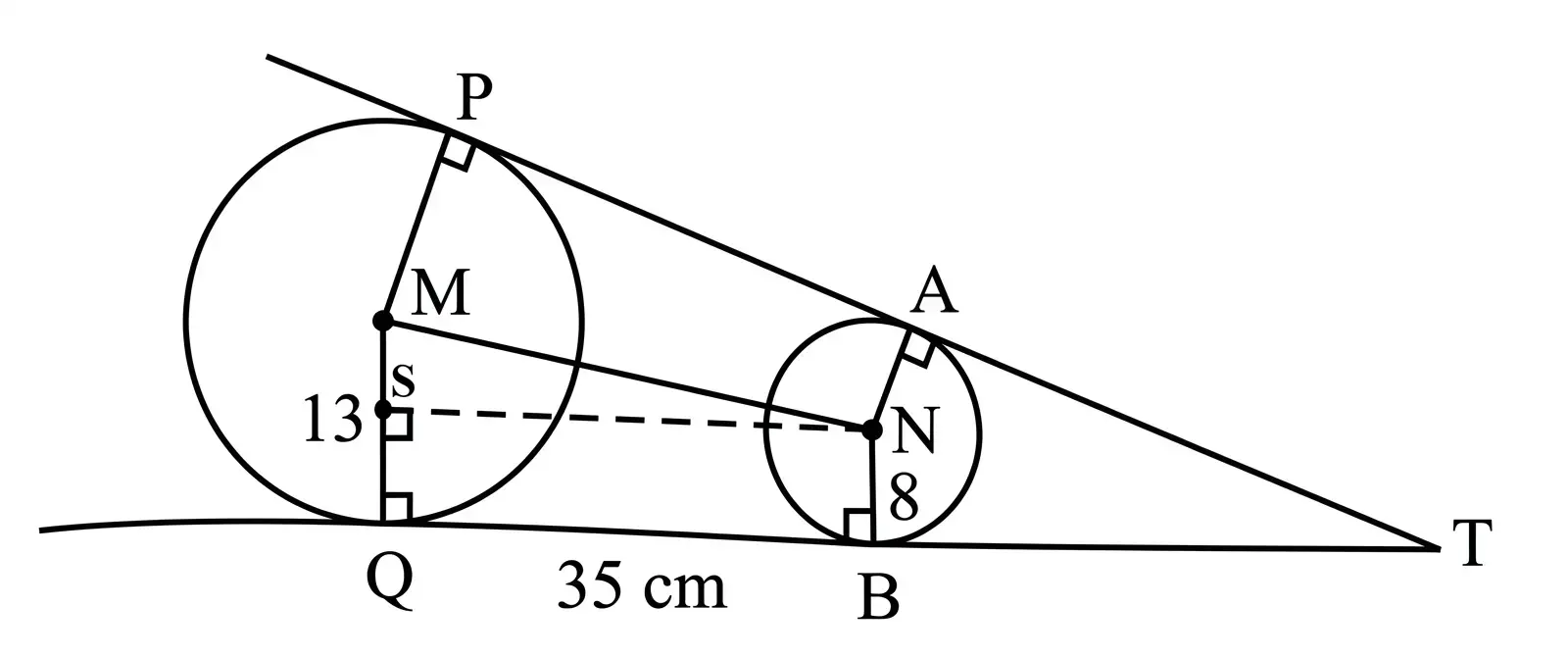
This line NS ǁ BQ, as NSQB forms a rectangle.
∴ MS = MQ – SQ = MQ – NB
= 13 – 8 = 5 cm
and SN = BQ = 35 cm
In right angled Δ MSN, by Pythagoras theorem,
MN 2 = MS 2 + SN 2
= (5) 2 + (35) 2
= 25 + 1225 = 1250
MN = √1250 = 25√2 cm
Therefore, Length of MN is 25√2 cm.
Please press the “Heart” button if you like the solution.
📚 Get Free Worksheet & Share Solution
To download the practice worksheet for this specific topic:
💬 Ask for WorksheetTo help your classmates with this helpful math solution:
Share with Friends