 Skip to content
Q) In the given figure, if a circle touches the side QR of a △PQR at S and extended sides PQ and PR at M and N respectively, then prove that : PM =1/2 (PQ + QR + PR).
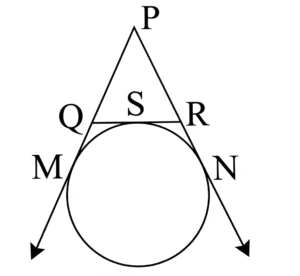
(Q27 B – 30/1/3 – CBSE 2026 Question Paper)
Ans:
From the diagram, we have a circle which touches QR at S and extended sides PQ and PR at M and N respectively.
Here, we need to prove: PM =  (PQ + QR + PR)
Step 1: By circle’s property of tangents, the tangents drawn from an external point to a circle are equal.
∴ PM = PN (tangents from point P)
and QS = QM (tangents from point Q)
and RS = RN (tangents from point R)
Step 2: Let’s express sides of Δ PQR in terms of tangents:
∴ PQ = PM – QM = PM – QS
(∵ QS = QM)
and PR = PN – RN = PN – RS
(∵ RS = RN)
and QR = QS + RS
Step 3: By adding all sides, we get:
∴ PQ + PR + QR = (PM – QS) + (PN – RS) + (QS + RS)
∴ PQ + PR + QR = 2 PM – QS – RS + QS + RS
∴ PQ + PR + QR = 2 PM – 
∴ PQ + PR + QR = 2 PM
∴ PM = (PQ + PR + QR)
Hence Proved !
Please press the “Heart” button if you like the solution.