
Q) Find the zeroes of the quadratic polynomial 2 x2 – (1 + 2√2) x + √2 and verify the relationship between zeroes and coefficients of the polynomial.
Q28 – Sample Question Paper – Set 1 – Maths Standard – CBSE 2026
Ans:
(i) In the given polynomial equation, to find zeroes, we will start with f(x) = 0
Therefore, 2 x2 – (1 + 2√2) x + √2 = 0
Step 1: Let’s start calculating the zeroes of the polynomial:
∵ 2 x2 – (1 + 2√2) x + √2 = 0
∴ 2 x2 – x – 2√2 x + √2 = 0
∴ x (2 x – 1) – √2 (2 x – 1) = 0
∴ (x – √2) (2 x – 1) = 0
∴ x = √2 and x = 
∴ the value of given polynomial will be zero for x = √2 and x =
Therefore, the zeroes of 2 x2 – (1 + 2√2) x + √2 are √2 and
(ii) Now, we need to verify the relationship between the zeroes and the coefficients of the polynomial.
Step 2: Let’s compare polynomial 2 x2 – (1 + 2 √2) x + √2 = 0 with standard quadratic equation a x2 + b x + c = 0, we get
a = 2, b = – (1 + 2 √2) and c = √2
Also, We calculated zeroes of the polynomial 2 x2 – (1 + 2√2) x + √2 in step 1 as: √2 and
let’s consider: α = √2 and β =
Step 3: Let’s start verifying the relationships one by one:
First, we take relationship 1 for sum of zeroes: α + β = 
In LHS: α + β
= √2 + = 
and RHS:
= 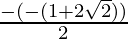 =
= 
Since LHS = RHS, the relation of sum of the zeros (α + β = ) is verified.
Step 4: we take relationship 2 for Product of zeroes, i.e. α × β = c / a
In LHS: α × β
= 
=  =
= 
and RHS: 
= =
Since LHS = RHS, the relationship of product of zeros (α . β = ) is also verified.
Therefore, √2 and are the zeroes of the polynomial. The relationship between the zeroes and coefficients is verified as α + β = ) and α . β =.
Please do press “Heart” button if you liked the solution.